daveramsey.com
Free Shipping Available

Dave's Investing Philosophy

from daveramsey.com on 14 Jul 2009

Want to know how Dave invests his money? Here’s your chance to find out! This guide is intended to help you understand what Dave has to say when it comes to the nuts and bolts of investing.

If you would like in-depth help to invest your money, contact your investing Endorsed Local Provider. Our investing ELPs are financial advisors that agree to help you invest the way Dave teaches. ELPs do not work for Dave but they are honest professionals and will make sure you understand your investments.

Special Note: Even though many people value Dave’s advice, you should not simply do what Dave does just because he’s Dave Ramsey. If you get the help of a financial advisor, even an ELP, you are responsible for making your own decisions. Never take a blind faith mentality when it comes to investing.

Dave's Investment Philosophy (printer-friendly) Dave's Investing Philosophy

Baby Steps:  Don’t start investing prior to completing Baby Step 3.

  1. $1,000 to start an emergency fund.
  2. Pay off all debt using the debt snowball.
  3. 3-6 months of expenses in savings.
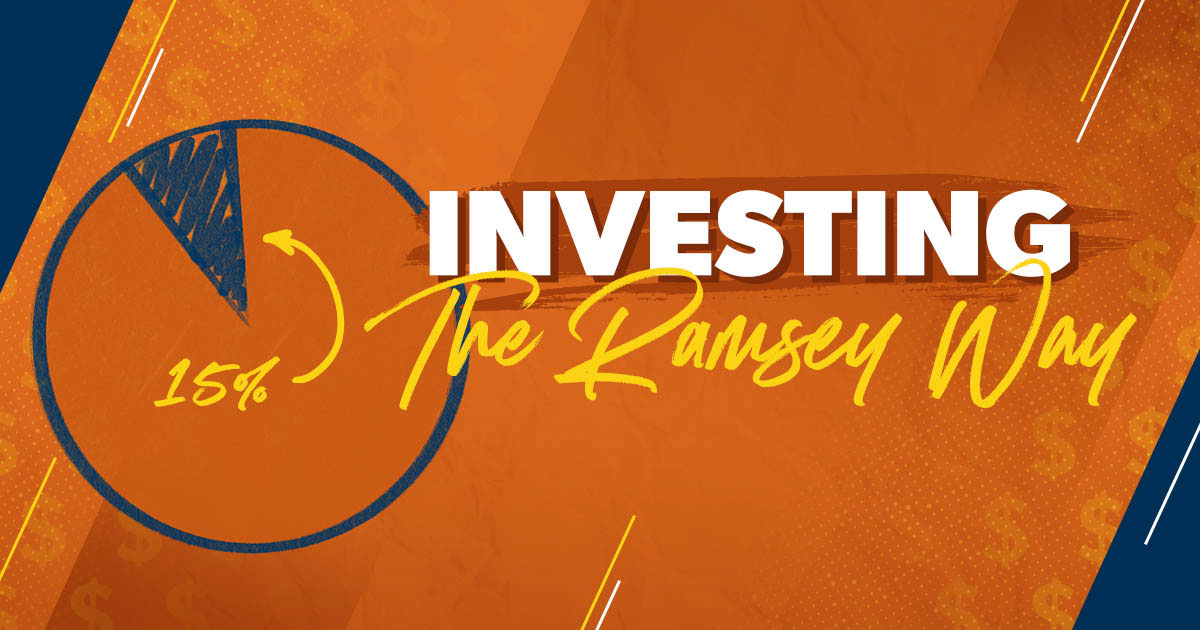
  4. Invest 15% of household income into Roth IRAs and pre-tax retirement.
  5. College funding for children.
  6. Pay off home early.
  7. Build wealth and give!  Continue to invest in mutual funds and real estate.


Investing For Those Just Getting Started:

  1. Be sure you have completed the first 3 Baby Steps.
  2. Begin by doing pre-tax savings in (401k, 403b, TSP, Traditional IRA) and tax-free savings (Roth IRA, Roth 401k)
NOTE:  If you receive a match in your (401k, 403b, TSP), invest here first up to the match.  Then, fully fund a Roth IRA for you (and your spouse, if married).  Then, come back to the (401k, 403b, TSP).
If you are still on Baby Steps 1-3, be patient; put off investing for now.  Avoiding a crisis with a fully funded emergency fund and paying off high-interest debts is a fantastic investment!


Mutual Funds:
25% into each of these four types of funds:

  • Growth
  • Growth & Income
  • Aggressive Growth
  • International

A shares (front end load); funds that are at least 5 years old or older; solid track record of acceptable returns within fund category.
*If risk tolerance is low, put less than 25% in aggressive growth or consider adding a “Balanced” fund to the four types of funds Dave suggests.


Single Stocks:
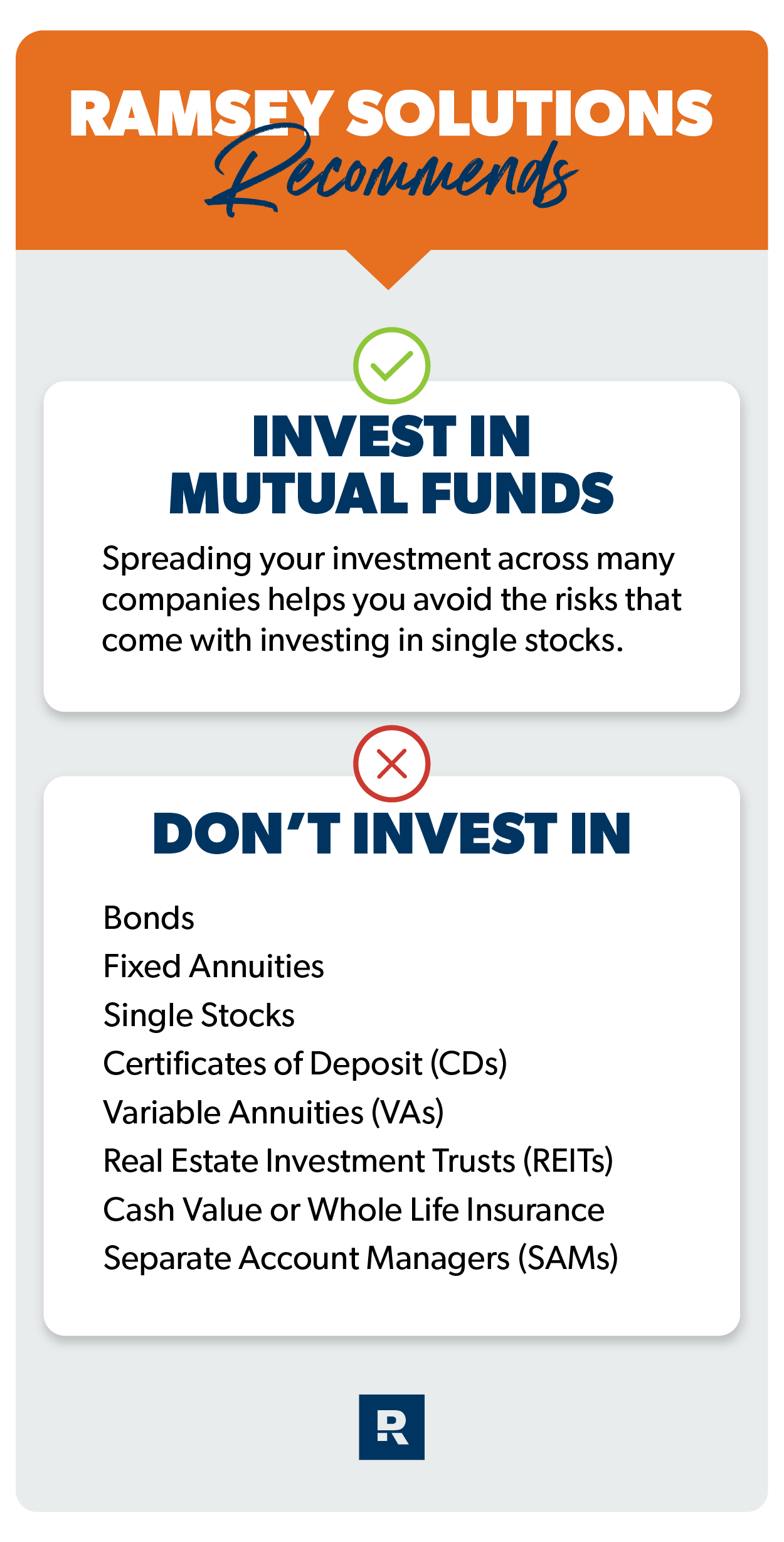
I do not own single stocks and do not suggest single stocks as part of your investment plan.  Single stock investors over long periods of time don’t consistently generate returns as high as mutual funds do.  If you really want to own a stock for some reason (company stock, for fun, etc.), limit single stocks to no more than 10% of your investment portfolio.

Certificates of Deposit: (CDs)
I suggest using CDs only for savings (for a purchase, taxes if you own a business, etc.); not for long term investing.  When using CDs, be aware of fine print for early withdrawals.  CDs carry a low rate of return.  As an investor, to get ahead you must earn a high enough rate of return to outpace inflation (3% to 4% per year) and to pay taxes on the gains if not inside a retirement account.  Most investors need to average a minimum of 6% per year over time to do these two things.

Bonds:
I do not own any bonds and do not suggest them as part of your investment plan.  Bonds carry the incorrect stereotype that they are safer with a slightly lower rate of return than equities.  Not true.  Single bonds can be very volatile and can actually go down significantly in value.  Bond mutual funds can at least be tracked for historical returns, but do not offer the returns equity mutual funds do. 

Fixed Annuities:
I do not own any fixed annuities and do not suggest them as part of your investment plan.    Simply stay away from these!

Variable Annuities:
Variable Annuities (VA’s) cause more confusion than any other financial product.  Here are some basics about VA’s           
What is it?

  • VA’s are a savings contract with a life insurance company.
  • They offer tax deferred growth on an after tax investment.
  • They offer beneficiary designation, which allows the account to be transferred to a beneficiary outside of probate court.
  • VA’s carry penalties if the contract is broken prior to the agreed upon time period, usually a declining surrender charge that lasts from six to eleven years.
  • 10% IRS penalty for withdrawing prior to age 59.5.
  • VA’s offer many bells and whistles, such as guarantees of principal, life insurance, etc.
  • VA fees vary widely.


Dave’s strong suggestions when considering VA’s:

  • Only consider VA's when you reach Baby Step 7.  In other words, you're debt free including your home and all other tax deferred options have been used.
  • VA’s can be useful investment tools because they allow your investments to grow tax deferred.
  • When purchasing VA’s understand the fees, surrender period, and any riders or options you choose.
  • When purchasing VA’s, stay with the four types of mutual funds I suggest inside the VA.


High income earners:

  • If a person earns too much to do a Roth IRA and is limited to what they can contribute to a 401k plan due to top heavy rules (unable to contribute 15% into pre tax or tax free investments), I recommend using either low turnover mutual funds or a combination of low turnover mutual funds and variable annuities. 
  • While an option for high income earners, I do not personally choose variable annuities at this point.


Worth mentioning:

  • Don’t commit to VA’s until you’re sure you are ready.  Once you’re in, you’re in. 
  • Never, ever, ever roll an IRA, 401k or 403b into a VA.  These three things already have the benefit of tax deferred growth and you do not need a VA.
  • I, myself, fit all the pre-requisites for VA’s; yet I do not personally own any.  I highly prefer mutual funds and paid for real estate for investors on Baby Step 7.


Investing For College:
I recommend investing the first $2,000 per year in an Education Savings Account, aka ESA, aka Coverdell Savings Account.  ESA’s are very simple and work much the way a personal IRA does.  When saving for a young child that will attend a public school, the ESA will usually be all you need.

For investing more than this amount or if your income exceeds $200,000 annually, choose a 529 plan.  The challenge with 529’s is that every state has a different 529 plan and they all vary in mechanics.  Some allow you to pick mutual funds, some require you to choose funds based on your child’s age, while others are pre-paid tuition programs. 

When choosing a 529 plan, I strongly suggest picking a plan that allows you to choose the funds up front and to keep those funds all the way up until time to use the funds for education.  Remember to stick with the four types of funds I suggests.  (Don’t use the pre-paid plans or ones that do age based asset allocation.)

Long Term Care Insurance:
I strongly recommend LTC as part of your plan at age 60.  Sales people in the LTC industry can be very enthusiastic about purchasing it prior to age 60.  Even so, I will be purchasing when I am 60.
Also, it is OK to purchase LTC even if you do not have a sizable estate to protect as long as the premiums are well within your budget.  An example might be a 60 year old couple with a plentiful current income; but not a large estate.  This couple may choose LTC simply for the quality of care it will provide them.

Disability Insurance:
I strongly suggest purchasing long term disability insurance as income replacement in the event you are disabled if affordable.  The cost of long term disability depends heavily on your occupation.  White collar employees carry less risk than blue collar employees and therefore are less expensive to insure.  For short term disabilities (90 to 180 days), I suggest having a fully funded emergency fund and do not recommend purchasing short term disability policies.

Life Insurance:
I strongly suggests purchasing 15 year (or longer) level term life insurance.  Purchase life insurance equal to 8 to 10 times your annual income.  The logic behind this is that a beneficiary could invest the entire amount into mutual funds, and draw 8% to 10% annually as income without actually consuming the original insurance amount.  Effectively, this replaces the income that was being generated by the deceased person.  Never purchase any type of cash value or permanent insurance such as whole life, variable life, universal life, etc.  Never cancel any old policy until the replacement policy is fully in force.

Exchange Traded Funds:  (ETFs)
I do not own ETFs and do not recommend them as part of your investment plan.  ETFs are baskets of single stocks that intend to operate like mutual funds; but they are not mutual funds.

Separate Account Managers:
SAM’s are third party investment professionals that buy and sell stocks or mutual funds on your behalf.  Put simply, I'm never going to get near this.  I'm sticking with the team of manager’s in large, old, experienced mutual funds.

Real Estate Investment Trusts: (REITs)
I do not own any REITs and do not suggest them as part of your investment plan.  As a category, REITs just don’t stack up to good growth stock mutual funds.  If you really want to invest in REITs, limit this to no more than 10% of your total investment portfolio.

Equity Indexed Annuities
I do not own Equity Indexed Annuities and do not suggest them as part of your investment plan.  Equity Indexed Annuities agree contractually to limit your loss while you agree to limit your gains.  I suggest investing directly into index funds if you want to follow an index such as the S&P 500 or similar.

Thrift Savings Plan:  (TSP) Dave’s suggestion is to invest:

  • 60% in C fund/plan
  • 20% in S fund/plan
  • 20% in I fund/plan


Values Based Investing:
I do not use a values based investing approach.  Long discussion made short:

  • I agree with the concept.  If you can pick between two similar mutual funds; one invests in things you agree with and the other in things you do not agree with, it makes sense to pick the one that aligns with your beliefs.
  • However, few of these funds stand up to my criteria for picking mutual funds (5 years old or older, long history of strong rates of return; professionally managed by a team of mutual funds managers, etc.)
  • This is a very personal decision you will have to make.  It’s what’s known as a slippery slope:  If you no longer invest in funds that might invest in a company that supports abortion, to be consistent, you will need to stop shopping at the grocer that sells pornography.  You would also need to stop banking because nearly all banks contribute to United Way, which supports Planned Parenthood.
  • Do not choose these funds out of guilt.  Do not make poor investment decisions to choose these funds.


Pay a Pro or Do it Yourself?
Pay a pro. I still choose to use a pro and suggest you do to. Statistics show that "do it yourselfers" are quick to jump out of funds when they begin to under perform.  A good professional advisor will remind you why you chose the fund and prevent you from buying high and selling low.

Commissions and Fees:

  • I suggest choosing A shares (upfront commissions). Long term, class A shares are much less expensive than B shares or C shares.
  • I do not personally choose fee based planning. (paying 1% to 2.5% annual fees for a brokerage account).  With an A share mutual fund, I pay an upfront load of 5% to 6% once. But with a fee based account, also known as a wrap account, you agree to pay a 1% to 2.5% fee every year - forever. As your account grows, the 1% to 2.5% fee will really add up.


Working With Your Advisor:
They advise, you make decisions.  This is very important.  You are paying them for advice and the ability to teach you enough to make smart decisions about your investments.  You are not handing over this responsibility because they are a professional or even because they are trusted by Dave Ramsey.  Retain ownership and responsibility for all final decisions.  Don’t invest in anything unless you can easily explain how the investment works to your spouse.  If you cannot communicate easily with your financial advisor, find one that does a better job of communicating.  Take your time and make wise decisions.

Seem too simple?  Investing doesn’t have to be complicated.  Dave fits all the profiles of a wealthy, knowledgeable investor; but he really does keep it as simple as you hear him teach on The Dave Ramsey Show each day.  Wealthy people find simple ways that work, and then do them over and over and over.  Happy Investing!

Find Dave's recommended advisor in your town today.

Post a Comment

I'd like to know what Dave's stance is on Roth 401(k) accounts. My job offer the traditional 401(k) with no match as well as the Roth 401(k) with no match. Which would Dave advise that I contribute to?

Ron March 17 2010 2:41 PM

Like @Anna, I am also curious about waiting until 60 for the LTC Insurance. Our sales manager was very convincing and stressed it's best to sign up young. My husband and I signed up with work over a year ago. Combined, we are paying $80 per month and we are "locked in" at that premium. If we wait until age 60, our premiums will be $400 per month. I'd like to know how cancelling LTC will benefit us. For example, we are 30 years old and if we keep paying $80 per month and begin to use the LTC insurance at age 75, we would have paid $43,200 in premiums. If we cancel now and wait until age 60 to purchase, still begin to use the insurance at age 75, we would have paid $72,000 in premiums. I'm having a hard time finding the benefit of cancelling now. We are on baby step 2 and would love to free up $80 per month, but don't want to regret it later. Thanks in advance for a response from DR staff - I always enjoy my lessons!

Mandy March 10 2010 2:03 PM

I have a comment on paying what you owe as compared to working your way arround it. Our initial agreement with the cc companies was to pay an initial interest rate. I know the fine print gives them the right to change it, but shouldn't it be within reason.. Who defines within reason? Jumping to 29.99 percent interest on a past balance seems unfair. Ohter financial insitutions use a small % plus prime as a guideline. I am current on everything right now but I have way tomuch cc debt, and the new rates are going to put me in a bad position. One I will probably not be able to maintain, mostly becuase my income is directly related to the economy. My question is when is it ok to go around the system and eliminate debt with the tools that are offered to us like debt reduction

Michael March 08 2010 2:57 PM

We're pushing 60 and regret choices that we made in our earlier years. We are now so "behind the eight ball". Now we want to tell all the young people we know to invest early and stay out of debt. Fortunately, we have gotten the message through to our young adult sons, who have already started their Roth IRAs. Oh, if we could only move back the hands of time. So, to all you young folks out there...invest early and STAY OUT OF DEBT!!!!

Lisa February 26 2010 2:45 PM

On the topic of mutual funds and retirement: 1) When you come close to retirement age, do you cash out these mutual funds or just leave them in and draw out what you need? 2) Given that the market goes down and I'm still investing 12% of my income to mutual funds (working on getting it up to 15%), then as the market keeps going down, i am buying more of the same stocks because it is cheaper now correct? Therefore when it goes back up I am gaining even more (dollar cost averaging)?

Darren February 24 2010 7:29 PM

I am single and live in an owner (me) occupied duplex. My mortgage is $1865 and I rent the other side for $700 a month. My question is when figuring my expenses each month for baby step #3 should I figure the entire mortgage or just my share of $1165?

Robert Jensen February 21 2010 5:07 PM

with the I Fund losing much in the last month; is now the time to jump into it. It has lost a lot as compared to the S Fund in Feb. Thanks for any TSP Fund comments

Mr T February 20 2010 6:20 PM

Re: Jennifer about mint.com. I've found mint.com to be a great way to identify my spending habits. However, it is driven by your online banking accounts, so if you don't utilize your bank's online banking product, you should move on. Also, you will want to review all your transactions within Mint to ensure they were classified correctly. You can customize your categories to match those of your personal Dave Ramsey-approved budget. As for safety, mint.com was recently purchased by Intuit (creator of TurboTax, Quickbooks, Quicken) which is a very strong, reputable company. As with any online security, protect your username/password, always log out of your session and your information will be quite safe. As a CPA, I've recommended it to many of my coworkers (I would recommend to clients, but I deal exclusively with corporations). Mint.com is good. Use it.

bryan February 15 2010 10:43 AM

I too am wondering about mint.com...is it safe, do you recommend it? I searched the site and didn't see anything other than Nick's question.

Jennifer February 10 2010 9:32 PM

I would have to agree whole-heartedly with Maykel in response to Mr. Hardin. I always laugh when I hear the index fund argument of "90% of actively managed funds dont even beat their index". Who are the people buying this 90% - I could show you dozens of portfolios of "load funds" that have, and will continue to, beat the 'market' time and time again. I think Dave said it best though on why you work with an advisor: an advisor is there to teach and coach you to make informed decisions. Phil Mickelson is one of the best golfers in the world, yet he pays Butch Harmon to be his golf coach. Why? Because he realizes his limitations and values professional guidance to become even better. The load/no-load debate isnt about fees folks - its about pride. When you get lost on a trip are you too proud to ask for directions? I'll bet most no-loaders are... I've used an advisor for 8 years now and we've outperformed the market every year (note I say we; because she teaches me and I make decisions - its a great team: like Butch and Phil!)

Mike Pruitt January 31 2010 9:46 AM

I agree that Index funds are not to be avoided. For people who do their own investing, go and take some classes at your Technical Colleges and learn everything about mutual funds. Save yourself the fee's. They are right to research carefully for the LT and stay with the plan. I'd rather be in charge and pay a mutual fund their expense then pay upfront loads etc. It's not as hard as you may think it is.

Deborah January 29 2010 10:23 PM

what do people think about mint.com...safe?

Nick Reece January 29 2010 2:38 PM

I am divorced with just enough income from spousal support to live paycheck to paycheck with about $100 left over each month. My ability to work is quite limited but I cannot collect disability. Since I will have no income when my ex retires (he is 61 and I am 60) what should I be focusing on to keep myself going through the later years? I will likely be getting about $100,000 from an estate in the next few years. Thanks for so much your advice!

Jean Hickey January 29 2010 10:14 AM

While on Christmas vacation at my sister and brother-in-law's home I listened to their CDs Financial Peace University. We were all glued to listening to each one at every opportunity all week - in the car and in the house. It brought us all close together and offered opportunities for amazing conversations. The program is fantastic and I want to save enough to buy the set for myself! I have been a fan of yours so listening to this program only reinforced whatI knew and it inspired me to try harder with m long term savings plan. Oh, and you are quite entertaining Dave. Many thanks!

Maggie January 27 2010 6:49 PM

Is the 15% into Roth and pre-tax accounts the cumulative amount over all accounts or 15% into each account? Thanks.

Fred January 25 2010 8:58 PM

Good common sense approach to money management

Michael Franklin January 21 2010 6:45 PM

Dave always uses the terms "Growth, Growth & Income, and Aggressive Growth". On the Fidelity website, I don't see these terms. Are these categories the same as Large, Mid, and Small Cap?

Mark Christiansen January 19 2010 1:31 PM

Dave, I retired in March of last year and started drawing Social Security. I am now working more hours 45+ a week. Would it be best for me to quit drawing Social Security at this time. I will probably be working at least another year with the company that I have worked for for 15+ years. I just hate the thought that of every two dollars I make I will only be receiving .50 cents when all is said and done. What do you think would be my best course of action. I just love your show and listen to you every day. I am trying my best at this time to follow your rules in getting out of debt. I appreciate you and thank you. God Bless you and yours. Cheryl Roussell

Cheryl Roussell January 17 2010 4:51 PM

Glad to see Dave recommends LTC insurance; anyone who's seen a parent deplete his or her savings on custodial care knows the value of this. However, I'd recommend not waiting to age 60 to purchase the policy, if you can afford it. First, the younger you are the lower the premiums are, and second (and most important) the world is full of people who become disabled in youth and middle age and whose families are devastated by the caregiving expense. Yes, some financial advisors tell you to wait and invest the money you'd spend in premiums when you're younger, but there's no way to factor out the possibility of needing the coverage in your younger or middle years.

Emily January 16 2010 3:30 AM

Dave, I am a public servant (police officer) with a " government pension" (at least for now) worth $42,000 after 32 years of service. I fully intend to work 32+ years. I am also investing in a 457 Deferred Compensation Program roughly $670 a month to supplement my retirement and lower my tax liability. How much percentage wise should I be investing in my 457?

Greg January 14 2010 7:46 AM

Buy and hold is a salesman's investing advice, be it managed funds or index funds. The key to long term gains is not to get greedy. When you have a nice profit, take the money off the table. I did that when gas hit $4 a gallon, because I figured it would sink the consumer economy. Then, when the market had lost 50%, I moved back into equities. Right now I'm betting against the dollar, and have moved substantial money into international funds and resource funds. I don't try to 'time' the market or day trade, but broad trends are obvious if you ignore the economists. My real return last year was 53%, but I only allow myself 20%, and move the rest of the profits into cash. If the world gets into a protectionist panic and the market tanks again, the reserves will go to buy equities. There is no risk to investing aggressively when the market is in the tank.

Larry Caldwell January 12 2010 3:14 PM

In reference to the debate between Index funds and Active funds comments I would side with the index guy. My portfolio is almost exactly 50/50 split between active and index. Based on reading Dave's stuff I am guessing he invests mainly with American Funds. American Funds have a good track record, but they also have high up front loads. The other commentor probably is a boogle head...aka Vanguard guy. I like Vanguard too, but I have focused on index funds for taxable investing and put some active funds in the tax advantaged funds. Dave briefly mentions low turnover funds as an alternative to Variable Annuities. I use Index funds partly because they are low turnover. The truth is though I still think the Index funds beat the American Funds over the long haul after you account for the fees.

Mark A. Schmidt January 12 2010 12:40 AM

Maykel, The market (read - Passively Managed Funds/Index Funds) has beaten Actively Managed Funds over the long term consistently. Why would you pay much more to a fund manager that has never, over the long term, beaten the market and charges you more, especially with higher expense ratios? Actively managed funds average 1.5% expense ratios. Passively manged funds average .2% expense ratios. On a $1 Million portfolio that's a difference of $13,000! Do you have any idea what that amount over 30 years would be at 11.8% average market return? I'm just an average guy who reads the right stuff - thus Ramsey. I respect Mr. Ramsey, I just happen to disagree with his investing philosophy for the above mentioned reasons.

Andrew Todd Hardin January 08 2010 11:32 PM

Why wait until you're 60 and the premiums are much higher to purchase Long Term Care Insurance?

Anna January 08 2010 4:21 PM

As an FYI, United Way makes it clear on their website that "some communities choose to support Planned Parenthood" (http://www.unitedway.org/worldwide/faq/faq.cfm?MID=70#parenthood) ... this is a PERFECT example for Dave's point ... even the best organizations will at times surprise and frustrate you if you attempt a values based investing approach. Thanks for always doing your homework, Dave!

Allen January 04 2010 2:58 PM

I am on the Board of Directors for a United Way in a rural county in Michigan. I can assure you that none of the 43 funded members in our county have anything to do with Planned Parenthood. I am a regular listener to the show but am very disappointed by the comments in Dave's investment philosophy's. Please use another example, as this one is not accurate.

Marcus January 01 2010 9:04 PM

I work for United Way, and we do not support Planned Parenthood. Donated money stays local and helps people in great need. Please help stop the rumors and do your homework. I love your show and what you stand for, but this comment makes me angry and ultimately hurts folks in need.

Lindsay December 30 2009 8:11 PM

@ Andrew Todd Hardin In reference to your comment about actively managed funds. With the right support and understanding, you can invest into funds that have outperformed indexes in every category (even after the fees). The main objective of $ managers and their analysts is to do this. They don't all do so, but with a little help and in knowing what to look for (track record, risk level-beta, objective, ranking, etc) you can create a portfolio superior in returns than any index funds.

Maykel December 30 2009 3:28 PM

I'm in debate with a Lt. Governor candidate in Alabama. He is a republican and support an "education lottery" and casino gambling. He's trying to throw the philosophy that mutual funds and life/health insurance are a form of gambling into the debate. How can I end this debate and hopefully turn his around? Thanks, Bryan Hutchins Satsuma, Alabama

Bryan Hutchins December 30 2009 2:56 PM

I sent my thoughts on why I thought that Dave's investment policy was incorrect due to the higher expenses incurred with actively managed funds and also lower returns with actively managed funds rather than low-cost index funds. I think it's important enough to receive a response from your staff. Especially because the investment advice is being taught all over the country. Please, Dave Ramsey staff, let me know your thoughts. I owe alot to Dave Ramsey but would like clarification on his investing philosophy, as I think it is extremely flawed.

Andrew Todd Hardin December 29 2009 6:09 PM

I listen to your radio show everyday - order my first set of books & financial DVD....can't wait for it to arrive! Merry Christmas to my family!! Thank you Dave for all you say & do!!!!

Stephie68 December 13 2009 8:44 PM

Dave Ramsey Rocks!!!

Danielle Snyder December 07 2009 9:11 PM

Dave, pulled up your website today and was very impressed with what I saw here today, good stuff just as you say on your daily radio show, catch you on KLIF 570 out of Dallas there alot. I am a truck driver and have had my share of disasterous ups and downs throughout my life, and have been implementing your progam( the baby steps) for quite some time without you having to tell me to do it. I grew up with that as a child and has been a challange to get there but I am doing it. Hope to be past BS-3 soon and keep up the good advice.

Karl Brock November 21 2009 11:39 PM

Post a Comment

Join the conversation, but be mindful of others!

We will remove inappropriate comments. Learn more about our comment policy.


Thank you for your comment.

Your comment will appear once it has been reviewed and approved by our staff.

Unfortunately, we receive lots of comments for some articles and can't post them all.

Whoops! We were unable to post your comment. Please try again.

Post another comment

  • Print
  • Comments
  • Bookmark and Share
Financial Peace University Online! Dave’s Life-Changing class now Online to fit your busy schedule! Learn More
Dave's School Curriculum: Empowering students to make sound financial decisions for life. Available for both Highschool and Homeschool  More Info
See Dave Live! The largest, most exciting event on personal finance in the nation! Find Tickets

Close Links

Open Links